
How to Summarize a Research Paper Using AI – Research papers are powerful, but let’s be honest, they’re also long, dense, and sometimes intimidating. If you’ve ever opened a 20-page academic paper and thought, “There must be a faster way to understand this,” you’re definitely not alone. That’s exactly why many students, researchers, and entrepreneurs are searching for how to summarize a research paper effectively, especially using AI tools.
But here’s the real challenge:
AI can help you summarize faster, yet if used incorrectly, it may remove important context, exaggerate findings, or even introduce errors. Recent research shows that AI-generated summaries sometimes overgeneralize scientific conclusions in 26% to 73% of cases, which means human verification is still essential.
So in this guide, we’ll walk through a practical, research-backed method on how to summarize a research paper using AI without losing key details. Think of this as a hybrid approach: AI does the heavy lifting, while you stay in control of accuracy. Let’s dive in.
Why Research Paper Summaries Matter More Than Ever
Before we talk about AI, let’s step back for a moment. Research papers can range from 15 to 25 pages or more, and reading every single one in full isn’t always realistic. That’s why summaries exist, to provide a concise overview of the key findings, methodology, and conclusions. In fact, a good research summary usually contains only the most important insights and is often around 10% of the original paper’s length.
Now imagine this scenario:
You’re doing research for:
- A startup idea
- A SaaS feature
- A blog article
- Academic work
- Market analysis
Instead of reading 20 papers fully, you summarize them quickly using AI, saving hours or even days. That’s exactly why learning how to summarize a research paper effectively has become a valuable skill in the AI era. But the key word here is effectively.
The Problem With AI Summaries (And Why You Should Care)
AI tools are incredibly powerful, but they’re not perfect. Some studies found that AI summaries can exaggerate results or oversimplify research findings, which may lead to misunderstandings. Other research also warns that AI may omit important limitations in studies, making conclusions sound broader than they actually are.
In simple terms:
AI is fast. But accuracy still depends on you.
This doesn’t mean you shouldn’t use AI, it just means you should use it the right way.
And that’s exactly what we’ll cover next.
Step-by-Step: How to Summarize a Research Paper Using AI
Let’s go through the most effective workflow used by researchers and professionals today.
Step 1: Start With the Abstract (Always)
Before you even open an AI tool, start with the abstract.
Most research papers already contain a short summary written by the author. This section gives you the research objective, methods, and main findings in just a few paragraphs.
Here’s a quick trick:
Read these sections first:
- Abstract
- Introduction
- Conclusion
These parts usually reveal the entire story of the paper.
Then ask yourself:
- What problem is this research solving?
- What method did the authors use?
- What are the main results?
Doing this first dramatically improves AI summaries later.
Step 2: Break the Paper Into Sections
One of the most effective techniques recommended by academic writing guides is dividing the paper into smaller parts.
Most research papers follow this structure:
- Introduction
- Literature Review
- Methodology
- Results
- Discussion
- Conclusion
Instead of asking AI to summarize the entire paper at once, try this approach:
Upload or paste one section at a time.
For example:
- First summarize the methodology
- Then summarize the results
- Then summarize the discussion
This prevents AI from missing important details.
And honestly, it works much better.
Step 3: Use AI to Extract Key Insights (Not Just Summaries)
Here’s where many people make mistakes.
They ask AI something like:
“Summarize this paper.”
That’s too vague.
Instead, use structured prompts like:
Better Prompt Example
Summarize this research paper with these sections:
1. Research Question
2. Methodology
3. Key Findings
4. Limitations
5. Practical Implications
Keep technical accuracy.
Why this works:
AI is forced to preserve important details.
Some AI tools designed specifically for academic work even extract structured elements like methods, results, and references automatically.
This approach is far more reliable.
Step 4: Verify the Summary Against the Original Paper
This step is critical.
Even advanced AI systems can make mistakes or exaggerate conclusions.
So here’s a quick verification checklist:
Check if the summary includes:
- The original research objective
- The dataset or sample size
- The research method
- The main findings
- The study limitations
If any of these are missing, the summary isn’t complete yet.
Step 5: Compress the Summary Without Losing Meaning
Now comes the final stage: refinement.
A good research summary should be:
- Clear
- Objective
- Concise
- Accurate
According to academic writing guidelines, summaries should focus on main ideas rather than every detail.
A good rule:
Think of it as explaining the research to a smart colleague who doesn’t have time to read the whole paper.
A Practical Example of AI-Assisted Research Summarization
Let’s say you’re researching AI adoption in startups.
You find a 20-page academic paper.
Instead of reading everything, you could do this:
Step 1 — Ask AI:
Explain the purpose of this research.
Step 2 — Ask AI:
Summarize the research methodology in simple terms.
Step 3 — Ask AI:
List the main findings and statistics.
Step 4 — Ask AI:
What are the limitations of this study?
Then combine everything into one summary.
This method is one of the most reliable ways to learn how to summarize a research paper with AI while maintaining accuracy.
Turn Hours of Reading Into Minutes with Smarter AI
Let’s be real for a second…
What if you didn’t need to juggle multiple tools, copy-paste sections, or manually structure summaries anymore?
What if how to summarize a research paper became a 5-minute task instead of a 2-hour struggle?
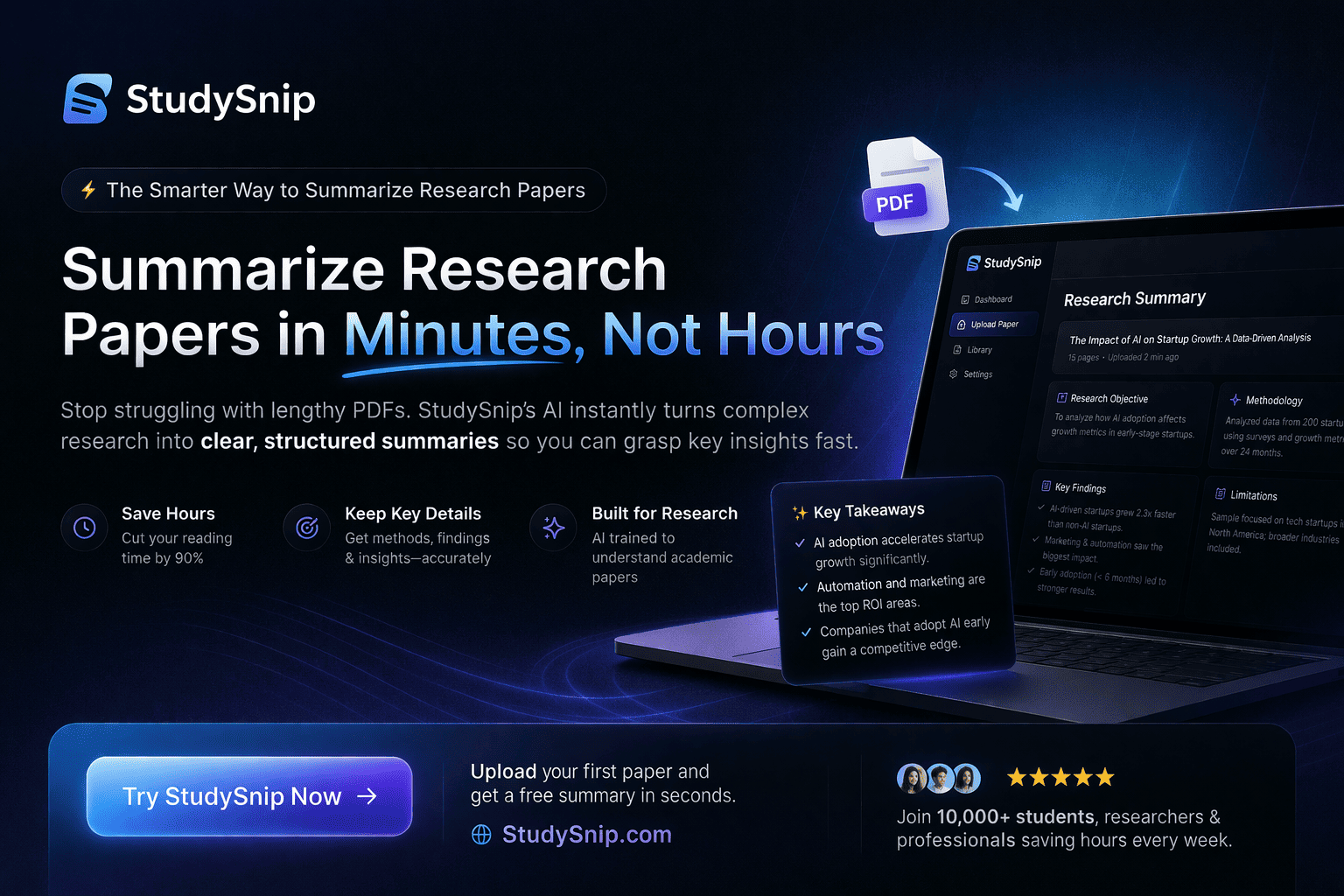
That’s exactly where StudySnip comes in.
Instead of using generic AI tools that give surface-level summaries, StudySnip is built specifically for research papers—which means it understands academic structure, key insights, and what actually matters.
Why StudySnip is Different
With StudySnip, you’re not just getting a summary—you’re getting a structured understanding of the research.
Here’s what makes it powerful:
- Automatically extracts research objectives, methods, and key findings
- Highlights important insights and data points
- Breaks down complex papers into clear, readable summaries
- Helps you avoid missing critical details or limitations
- Designed for students, founders, researchers, and content creators
So instead of asking AI vague questions and hoping for the best…
You get a system that already knows how to summarize a research paper properly.
Imagine This Workflow
You upload a research paper…
Within minutes, you get:
- A clean summary
- Key takeaways
- Structured insights ready to use
No overwhelm. No confusion.
Just clarity.
Ready to Try It?
If you’re serious about saving time and improving accuracy, it’s worth giving StudySnip a try. Because once you experience how fast and structured research summarization can be… You won’t want to go back.
A Smarter Framework Researchers Are Using Today.
Here’s a powerful workflow used by many researchers:
The 5-Layer AI Research Summary Method
- Layer 1 – Paper Overview
- Layer 2 – Research Problem
- Layer 3 – Methods & Data
- Layer 4 – Key Results
- Layer 5 – Limitations & Future Work
If you structure your summary this way, you won’t lose key details.
Final Thoughts: Mastering How to Summarize a Research Paper With AI
Learning how to summarize a research paper today is no longer just an academic skill—it’s a productivity superpower.
Whether you’re a student, founder, content creator, or researcher, the ability to quickly extract insights from academic work can give you a major advantage.
Here’s the simple formula to remember:
- Read the abstract first
- Break the paper into sections
- Use structured AI prompts
- Verify findings carefully
- Compress without losing meaning
Follow this process, and you’ll be able to use AI to summarize research papers faster, smarter, and more accurately—without losing the details that matter.
And once you master this workflow, you’ll realize something interesting:
You’re not just summarizing research anymore. You’re accelerating learning itself.